First, the obligatory picture of Hannah Spearritt :-)
Women have a harder time losing weight than men. Women retain water more than men for hormonal reasons, but a factor that's overlooked is that, on average, healthy women have higher body-fat percentages than healthy men. This is because women have babies and men don't. Who knew? On the plus side, women produce more DHA than men.
Why should having higher body-fat percentages make a difference to weight loss? See What is the required energy deficit per unit weight loss? The energy deficit required to lose 1lb of body-weight increases with increasing body-fat percentage. It's rarely 3,500kcals per lb.
If you really love mathematics, see The Dynamics of Human Body Weight Change by Carson C. Chow and Kevin D. Hall.
From the above paper:- ΔU = ΔQ - ΔW
where ΔU is the change in stored energy in the body, ΔQ is a change in energy input or intake, and ΔW is a change in energy output or expenditure. This is the Energy Balance Equation. As I said back in Back to black, CIAB, pharmaceutical drug deficiencies & nerds.
Where body weight is concerned, calories count (but don't bother trying to count them).
Where body composition is concerned, partitioning counts.
Where health is concerned, macronutrient ratios, EFAs, minerals, vitamins & lifestyles count.
N.B. Poor health can adversely affect body weight and/or body composition, by increasing appetite and/or by adversely affecting partitioning.
Tampilkan postingan dengan label Calorie. Tampilkan semua postingan
On burning, storing and recomposing.
Burning
I couldn't resist!On my adventures around the interwebs, I've noticed the following:- "Humans aren't Calorimeters. Therefore calories are irrelevant to humans." While I agree with the first sentence, I don't agree with the second one.
Calorimeters burn (oxidise) foods at high temperatures with a flame using oxygen, which produces carbon dioxide, water (depending on what's being burned) & heat energy.
Humans burn (oxidise) foods at 37ºC with enzymes , charge transporters etc using oxygen, which produces carbon dioxide, water (depending on what's being burned), mechanical energy & heat energy.
As both oxygen & carbon dioxide are gases, these can be measured by a respiratory gas analyser, to establish the rate of burning and what's being burned at any instant. See It's all in a day's work (as measured in Joules). When resting, burning occurs at a rate of ~1kcal/minute and, as it's measured while fasted, ~0.11g/min of fat is burned, & ~0.01g/min of carbohydrate is burned. Also note that a lot of mechanical energy can be produced, which can increase the rate of burning by a factor of seventeen.
In conclusion, humans burn (oxidise) foods, though not with a flame, and they can produce mechanical energy in addition to heat energy. The rate of burning and what's being burned at any instant can be measured.
Storing
When we eat food, it's digested and absorbed. As a digested meal is absorbed, it appears in the blood as glucose, triglycerides & amino acids. These then disappear from the blood due to burning and storage. See Extended effects of evening meal carbohydrate-to-fat ratio on fasting and postprandial substrate metabolism.Figure 1 shows the effects of a 100g Oral Glucose load or a 40g Oral Fat load on blood glucose level over a period of 360 minutes. Note that subjects are resting during the 360 minutes. As the 100g Oral Glucose load produces a large insulin response (See Figure 2), fat-burning temporarily stops. Therefore, the ~1kcal/minute resting burning rate is derived 100% from carbohydrate. Therefore, the carbohydrate-burning rate is ~0.25g/min. At this rate, it would take ~400 minutes to burn 100g of glucose. However, it actually takes ~180 minutes for blood glucose level to fall from maximum to minimum. Therefore, some of the glucose from the Oral Glucose load is stored (mostly as glycogen in muscles and liver).
Figure 3B shows the effects of a 100g Oral Glucose load or a 40g Oral Fat load on blood triglyceride (fat) level over a period of 360 minutes. Note that subjects are resting during the 360 minutes. As the 40g Oral Fat load produces no significant insulin response (See Figure 2), fat-burning is unaffected. Therefore, the fat-burning rate is ~0.11g/min. At this rate, it would take ~364 minutes to burn 40g of fat. However, it actually takes 180 to 240 minutes for blood triglyceride (fat) level to fall from maximum to minimum. Therefore, some of the fat from the Oral Fat load is stored (as fat in adipocytes), even though there is no significant insulin response.
Therefore there are times when stuff is stored (anabolism) and there are times when stuff is withdrawn from stores (catabolism). If more stuff is stored than is withdrawn over a period of time, weight goes up, and vice-versa.
Recomposing
After doing intense exercise e.g. sprinting, resistance training with weights etc, muscles become very sensitive to insulin. Therefore, if intense exercise is done just before stuff is stored, amino acids & glucose are preferentially stored in muscles rather than adipocytes. This increases muscle mass relative to fat mass.If non-intense exercise is done at times when stuff is withdrawn from stores, this maximises the amount of fat withdrawn from adipocytes and minimises the amount of amino acids withdrawn from muscles. This decreases fat mass relative to muscle mass.
It's therefore possible to increase muscle mass at certain times and decrease fat mass at other times, while keeping overall mass relatively constant i.e. it's possible to gain muscle and lose body-fat without being in an overall caloric deficit. See Body Recomposition.
Label:
Burning,
Calorie,
Calories,
Carbohydrates,
Fat,
Fat oxidation,
Fats,
Muscle,
Obesity,
Protein,
Proteins,
Recomposition
It's all in a day's work (as measured in Joules) Part 2.
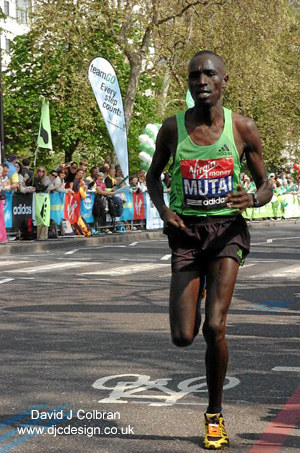
Are you as aerobically-fit as this bloke?
Emmanuel Mutai made it a Kenyan double after winning the Virgin London Marathon in a new course record. Mutai's time of 2:04.38, beats the previous best of 2:05.10 set by Samuel Wanjiru in 2009 and also the fifth-fastest time ever.
I'll take it that's a "no", then.
Elite marathon runners have optimised their metabolisms to use the minimum possible amount of muscle glycogen as fuel. Muscle glycogen storage is limited to ~1,680kcals-worth (~420g of carb)*.
Supercompensation (depletion followed by 3 days of carb-loading) can increase this figure to ~720g*.
Fat storage can amount to ~35,000kcals-worth (~10lb of fat), even in a skinny Kenyan like Mutai.
A blogger called Thor Falk took the data from It's all in a day's work (as measured in Joules) and plotted it as a graph in Fat vs carb burning – a N=1 chart. Here's the graph:-
Even a super-fit Kenyan like Mutai burns some carbs when running at ~12.5 miles per hour. The less fit that somebody is, the more the first corner in the blue plot moves down and to the left. This results in more carbs being burned at energy consumption levels more than the first corner. This depletes muscle glycogen stores faster, resulting in "hitting the wall" (running out of muscle glycogen) sooner.
Muscles that are depleted of glycogen are more insulin-sensitive than muscles that have more glycogen, therefore the less aerobically-fit somebody is, the sooner their muscles become insulin-sensitive when they exercise.
*Assuming 20kg of muscle (Lore of Running P104)
I'll take it that's a "no", then.
Elite marathon runners have optimised their metabolisms to use the minimum possible amount of muscle glycogen as fuel. Muscle glycogen storage is limited to ~1,680kcals-worth (~420g of carb)*.
Supercompensation (depletion followed by 3 days of carb-loading) can increase this figure to ~720g*.
Fat storage can amount to ~35,000kcals-worth (~10lb of fat), even in a skinny Kenyan like Mutai.
A blogger called Thor Falk took the data from It's all in a day's work (as measured in Joules) and plotted it as a graph in Fat vs carb burning – a N=1 chart. Here's the graph:-
Muscles that are depleted of glycogen are more insulin-sensitive than muscles that have more glycogen, therefore the less aerobically-fit somebody is, the sooner their muscles become insulin-sensitive when they exercise.
*Assuming 20kg of muscle (Lore of Running P104)
It's all in a day's work (as measured in Joules)
The title is from the "Physics Man" sketch on The Now Show. Work is another word for energy and there are two different units for it.
The calorie (cal) is the amount of energy required to heat 1g of water by 1°C. This is a tiny amount of energy. The dietary Calorie (Cal) = 1,000cal = 1kcal.
The Joule (J) is the SI unit of energy. 1J = 1kg*m^2/s^2.
1Joule/sec = 1Watt (W).
1kcal = 4.186kJ.
At rest, an average human body uses ~1kcal/min = ~4,186J/min = ~69.8J/sec = ~69.8W.
The brain uses ~5g of glucose/hour = 18.75kcal/hour (1g of carb = 3.75kcals, usually rounded-up to 4) = 78487.5J/hour = ~21.8W.
The heart uses ~10W. The liver, kidneys, gut and lungs run continuously so they use energy all of the time.
Skeletal muscle uses a variable amount of energy using a variable proportion of fuels, depending on what you're doing with it. A chap called Steve sent me a spreadsheet of results in 2004 when he underwent a metabolic test on a stationary bike while breathing through a respiratory gas analyser, which calculated kcals burned and fuel usage by measuring Respiratory Exchange Ratio (RER).
At~1kcal/min (resting), he burned ~95% from fat (~0.11g/min), ~5% from carbs (~0.01g/min).
At 2kcal/min (12% max), he burned 100% from fat (0.22g/min), 0% from carbs (0.00g/min).
At 3kcal/min (18% max), he burned 100% from fat (0.33g/min), 0% from carbs (0.00g/min).
At 4kcal/min (24% max), he burned 99% from fat (0.44g/min), 1% from carbs (0.01g/min).
At 5kcal/min (29% max), he burned 48% from fat (0.27g/min), 52% from carbs (0.69g/min).
At 6kcal/min (35% max), he burned 62% from fat (0.41g/min), 38% from carbs (0.61g/min).
At 7kcal/min (41% max), he burned 58% from fat (0.45g/min), 42% from carbs (0.78g/min).
At 8kcal/min (47% max), he burned 46% from fat (0.41g/min), 54% from carbs (1.15g/min).
At 9kcal/min (53% max), he burned 42% from fat (0.53g/min), 58% from carbs (1.39g/min).
At 10kcal/min (59% max), he burned 44% from fat (0.49g/min), 56% from carbs (1.49g/min).
At 11kcal/min (65% max), he burned 38% from fat (0.46g/min), 62% from carbs (1.82g/min).
At 12kcal/min (71% max), he burned 41% from fat (0.55g/min), 59% from carbs (1.89g/min).
At 13kcal/min (76% max), he burned 37% from fat (0.53g/min), 63% from carbs (2.18g/min).
At 14kcal/min (82% max), he burned 30% from fat (0.47g/min), 70% from carbs (2.61g/min).
At 15kcal/min (88% max), he burned 14% from fat (0.23g/min), 86% from carbs (3.44g/min).
At 16kcal/min (94% max), he burned 0% from fat (0.00g/min), 100% from carbs (4.27g/min).
At 17kcal/min (100% max), he burned 0% from fat (0.00g/min), 100% from carbs (4.53g/min).
Over a wide range of intensities, the number of grams of fat Steve burned/min was fairly constant.
Note that 17kcals/min = 1186.6W, or 1.19kW. This level can be maintained for only a few seconds, as carbs are burned both aerobically and anaerobically, which exhausts PhosphoCreatine stores in muscles and also causes an accumulation of lactate in muscles. See Why do muscles hurt after exercise?
Muscle mass is very metabolically-active compared to fat mass, as one pound of fat mass burns only about 2kcal a day. See also Dissecting the Energy Needs of the Body – Research Review
Here's another Physics Man.
The calorie (cal) is the amount of energy required to heat 1g of water by 1°C. This is a tiny amount of energy. The dietary Calorie (Cal) = 1,000cal = 1kcal.
The Joule (J) is the SI unit of energy. 1J = 1kg*m^2/s^2.
1Joule/sec = 1Watt (W).
1kcal = 4.186kJ.
At rest, an average human body uses ~1kcal/min = ~4,186J/min = ~69.8J/sec = ~69.8W.
The brain uses ~5g of glucose/hour = 18.75kcal/hour (1g of carb = 3.75kcals, usually rounded-up to 4) = 78487.5J/hour = ~21.8W.
The heart uses ~10W. The liver, kidneys, gut and lungs run continuously so they use energy all of the time.
Skeletal muscle uses a variable amount of energy using a variable proportion of fuels, depending on what you're doing with it. A chap called Steve sent me a spreadsheet of results in 2004 when he underwent a metabolic test on a stationary bike while breathing through a respiratory gas analyser, which calculated kcals burned and fuel usage by measuring Respiratory Exchange Ratio (RER).
At~1kcal/min (resting), he burned ~95% from fat (~0.11g/min), ~5% from carbs (~0.01g/min).
At 2kcal/min (12% max), he burned 100% from fat (0.22g/min), 0% from carbs (0.00g/min).
At 3kcal/min (18% max), he burned 100% from fat (0.33g/min), 0% from carbs (0.00g/min).
At 4kcal/min (24% max), he burned 99% from fat (0.44g/min), 1% from carbs (0.01g/min).
At 5kcal/min (29% max), he burned 48% from fat (0.27g/min), 52% from carbs (0.69g/min).
At 6kcal/min (35% max), he burned 62% from fat (0.41g/min), 38% from carbs (0.61g/min).
At 7kcal/min (41% max), he burned 58% from fat (0.45g/min), 42% from carbs (0.78g/min).
At 8kcal/min (47% max), he burned 46% from fat (0.41g/min), 54% from carbs (1.15g/min).
At 9kcal/min (53% max), he burned 42% from fat (0.53g/min), 58% from carbs (1.39g/min).
At 10kcal/min (59% max), he burned 44% from fat (0.49g/min), 56% from carbs (1.49g/min).
At 11kcal/min (65% max), he burned 38% from fat (0.46g/min), 62% from carbs (1.82g/min).
At 12kcal/min (71% max), he burned 41% from fat (0.55g/min), 59% from carbs (1.89g/min).
At 13kcal/min (76% max), he burned 37% from fat (0.53g/min), 63% from carbs (2.18g/min).
At 14kcal/min (82% max), he burned 30% from fat (0.47g/min), 70% from carbs (2.61g/min).
At 15kcal/min (88% max), he burned 14% from fat (0.23g/min), 86% from carbs (3.44g/min).
At 16kcal/min (94% max), he burned 0% from fat (0.00g/min), 100% from carbs (4.27g/min).
At 17kcal/min (100% max), he burned 0% from fat (0.00g/min), 100% from carbs (4.53g/min).
Over a wide range of intensities, the number of grams of fat Steve burned/min was fairly constant.
Note that 17kcals/min = 1186.6W, or 1.19kW. This level can be maintained for only a few seconds, as carbs are burned both aerobically and anaerobically, which exhausts PhosphoCreatine stores in muscles and also causes an accumulation of lactate in muscles. See Why do muscles hurt after exercise?
Muscle mass is very metabolically-active compared to fat mass, as one pound of fat mass burns only about 2kcal a day. See also Dissecting the Energy Needs of the Body – Research Review
Here's another Physics Man.
Label:
Calorie,
Carbohydrates,
Energy,
Fat,
Joules,
kcal,
kJ,
Obesity,
RER,
Substrate utilisation
Everyone is Different.
If there's one thing I've learned over the years of research into Diet and Nutrition, it's this: Everyone is Different. When I first discovered low-carbohydrate diets (thanks to the late Dr Robert C. Atkins M.D.), I thought that it was the One True Diet, and I became a bit of an "Atkins bore" telling everyone how wonderful it was and suggesting that everyone should be on it. I now know that what suits me doesn't necessarily suit everyone else.
To illustrate how variable people are, here's Fig. 2 from Determinants of the variability in respiratory exchange ratio at rest and during exercise in trained athletes. Used with permission.
Respiratory Exchange Ratio (RER) (a.k.a. Respiratory Quotient (RQ)) is the ratio of carbon dioxide breathed out to oxygen breathed in. This ratio depends on the fuels that the body is burning for energy. For example, if the body is burning 100% fats, RER = 0.7. If the body is burning 100% carbohydrates aerobically, RER=1.0. If the body is burning 100% carbohydrates anaerobically (flat-out sprinting), RER > 1.0. RER goes up and down depending on intensity of exercise, food intake (eating protein and/or carbohydrate increases it and extended fasting reduces it). Increasing cardiovascular fitness reduces RER.
The top diagram is a histogram of fasted RER and % fat oxidation vs. number of subjects. At the left-hand end of the histogram, there are two cyclists with a fat oxidation of 93 - 100%. At the right-hand end of the histogram, there is one cyclist with a fat oxidation of 20 - 27%.
There's a helluva difference between burning 93 - 100% fats at rest and burning 20 - 27% fats at rest. Average fat oxidation is 66%, which means that average carbohydrate oxidation is 34%. So, on average, at rest, people burn twice as much energy from fats as from carbohydrates. So, why do current "Healthy Eating" guidelines recommend almost twice as much energy from carbohydrates as from fats for everyone, including sedentary people?
As exercise intensity increases, the peak in the histogram shifts to the right as shown in the lower diagram. At 25% full work-load, mean fat oxidation is ~53%. At 50% full work-load, mean fat oxidation is ~37% and at 75% full work-load, mean fat oxidation is ~13%.
I suspect that at 100% full work-load, mean fat oxidation is 0% i.e. 100% of energy is obtained from carbohydrates when sprinting. Somebody on a very-low-carbohydrate diet like Atkins induction (~20g net carbs/day) could keel over with hypoglycaemia if they exercise for too long at too high an intensity.
As there is so much variation from person to person, you must find out for yourself your own optimum proportions of proteins, fats & carbohydrates, and these depend upon the intensity & volume of exercise you do. It all sounds rather complicated, but it isn't really.
Apply the principle of "Eat, monitor & adjust accordingly" as Toxic Toffee (ex-Muscletalk member) always used to say. The eating bit will be covered in future Blog posts. The monitoring bit doesn't necessarily involve bathroom scales.
Hang on. Isn't "dieting" all about losing excess weight? Not necessarily. Remember the old joke?
Q. What's the best way to lose 5lbs of ugly flab?
A. Cut off your head!
As your body is made of water, muscle, fat, bones, cartilage, tendons, organs, glycogen, skin etc and your scales can't tell the difference between them, losing weight the wrong way can make you less healthy. However, losing weight the right way will make you more healthy.
If you starve, skip breakfast or go for a long run before breakfast, as your body is lacking glycogen reserves & amino acids, a large amount of a corticosteroid hormone called cortisol is secreted, which increases the conversion of muscle into amino acids, then glucose. It also suppresses the immune system and weakens skin & bones.
Unless you have a lot of muscle mass to spare, it's body-fat that you should be losing, and to monitor this, either use a tape-measure around your waist, check how loose/tight your clothes are, or strip-off and jump up & down in front of a full-length mirror. As Big Les (Muscletalk Moderator) says, "If it jiggles, it's fat!".
So, what happens if you eat too much carbohydrate but your body doesn't burn it fast enough? Initially, carbohydrate intake tops-up liver and muscle glycogen stores, which increases carbohydrate-burning to compensate. The liver can store about 70g of glycogen and muscles can store about 400g of glycogen. If, despite increased carbohydrate-burning, more carbohydrate is consumed than is burned, glycogen stores continue to fill. When glycogen stores become full, RER increases to 1.0 and 100% of energy is derived from carbohydrate. Getting 100% of energy from carbohydrate means that zero fat is burned, so filling glycogen stores to the brim by eating too much carbohydrate is not a good idea if you want to burn some body-fat.
Once glycogen stores are full, any additional intake of carbohydrate beyond that which is burned passes through the lipogenesis pathway - this basically means that carbs are turned into fat - which may end up as liver fat. But there's even worse news. Fat is secreted by the liver into the blood as triglycerides. This is bad for the cholesterol particles in your blood. See Cholesterol and Coronary Heart Disease. What happens if you eat too few carbs? As stated above, a "carbohydrate-burner" taking in insufficient carbohydrates could get hypoglycaemia & keel over.
How many grams of carbohydrate per day does it take to promote lipogenesis? Someone at rest burns ~1kcal/minute. If this is derived 100% from carbohydrate, this is equivalent to 0.25g of carbohydrate/minute, or 15g of carbohydrate/hour, or 360g of carbohydrate/day. Therefore, sedentary people who consistently eat more than 360g of carbohydrate/day will probably produce significant triglycerides. People who have The Metabolic Syndrome/Syndrome-X (a high proportion of people who have excess belly fat) have increased lipogenesis and higher serum triglycerides than healthy people.
Discussing weight again for a moment, it's often said that all diets are the same, as weight loss is all about calories. This is true. See Is a Calorie a Calorie? However, body composition is determined by a combination of macro-nutrient proportions (i.e. the relative amounts of proteins, carbohydrates and fats in the diet) and the intensity & volume of exercise. Health is determined by a combination of micro-nutrient proportions (i.e. vitamins, minerals & anutrients) and exercise.
If you're only interested in weight loss, just count calories. If you wish to lose body-fat without losing muscle mass, you need to know what proportions of proteins, carbohydrates & fats to eat (it's really not that critical, but many people get it wrong). You need to know the difference between good carbs & bad carbs, and good fats & bad fats. You need to know the best times to eat proteins, carbohydrates & fats relative to exercise (it's also really not that critical, but many people get it wrong). You need to know the difference between good exercise & bad exercise.
Continued on We are not all the same.
To illustrate how variable people are, here's Fig. 2 from Determinants of the variability in respiratory exchange ratio at rest and during exercise in trained athletes. Used with permission.
The top diagram is a histogram of fasted RER and % fat oxidation vs. number of subjects. At the left-hand end of the histogram, there are two cyclists with a fat oxidation of 93 - 100%. At the right-hand end of the histogram, there is one cyclist with a fat oxidation of 20 - 27%.
There's a helluva difference between burning 93 - 100% fats at rest and burning 20 - 27% fats at rest. Average fat oxidation is 66%, which means that average carbohydrate oxidation is 34%. So, on average, at rest, people burn twice as much energy from fats as from carbohydrates. So, why do current "Healthy Eating" guidelines recommend almost twice as much energy from carbohydrates as from fats for everyone, including sedentary people?
As exercise intensity increases, the peak in the histogram shifts to the right as shown in the lower diagram. At 25% full work-load, mean fat oxidation is ~53%. At 50% full work-load, mean fat oxidation is ~37% and at 75% full work-load, mean fat oxidation is ~13%.
I suspect that at 100% full work-load, mean fat oxidation is 0% i.e. 100% of energy is obtained from carbohydrates when sprinting. Somebody on a very-low-carbohydrate diet like Atkins induction (~20g net carbs/day) could keel over with hypoglycaemia if they exercise for too long at too high an intensity.
As there is so much variation from person to person, you must find out for yourself your own optimum proportions of proteins, fats & carbohydrates, and these depend upon the intensity & volume of exercise you do. It all sounds rather complicated, but it isn't really.
Apply the principle of "Eat, monitor & adjust accordingly" as Toxic Toffee (ex-Muscletalk member) always used to say. The eating bit will be covered in future Blog posts. The monitoring bit doesn't necessarily involve bathroom scales.
Hang on. Isn't "dieting" all about losing excess weight? Not necessarily. Remember the old joke?
Q. What's the best way to lose 5lbs of ugly flab?
A. Cut off your head!
As your body is made of water, muscle, fat, bones, cartilage, tendons, organs, glycogen, skin etc and your scales can't tell the difference between them, losing weight the wrong way can make you less healthy. However, losing weight the right way will make you more healthy.
If you starve, skip breakfast or go for a long run before breakfast, as your body is lacking glycogen reserves & amino acids, a large amount of a corticosteroid hormone called cortisol is secreted, which increases the conversion of muscle into amino acids, then glucose. It also suppresses the immune system and weakens skin & bones.
Unless you have a lot of muscle mass to spare, it's body-fat that you should be losing, and to monitor this, either use a tape-measure around your waist, check how loose/tight your clothes are, or strip-off and jump up & down in front of a full-length mirror. As Big Les (Muscletalk Moderator) says, "If it jiggles, it's fat!".
So, what happens if you eat too much carbohydrate but your body doesn't burn it fast enough? Initially, carbohydrate intake tops-up liver and muscle glycogen stores, which increases carbohydrate-burning to compensate. The liver can store about 70g of glycogen and muscles can store about 400g of glycogen. If, despite increased carbohydrate-burning, more carbohydrate is consumed than is burned, glycogen stores continue to fill. When glycogen stores become full, RER increases to 1.0 and 100% of energy is derived from carbohydrate. Getting 100% of energy from carbohydrate means that zero fat is burned, so filling glycogen stores to the brim by eating too much carbohydrate is not a good idea if you want to burn some body-fat.
Once glycogen stores are full, any additional intake of carbohydrate beyond that which is burned passes through the lipogenesis pathway - this basically means that carbs are turned into fat - which may end up as liver fat. But there's even worse news. Fat is secreted by the liver into the blood as triglycerides. This is bad for the cholesterol particles in your blood. See Cholesterol and Coronary Heart Disease. What happens if you eat too few carbs? As stated above, a "carbohydrate-burner" taking in insufficient carbohydrates could get hypoglycaemia & keel over.
How many grams of carbohydrate per day does it take to promote lipogenesis? Someone at rest burns ~1kcal/minute. If this is derived 100% from carbohydrate, this is equivalent to 0.25g of carbohydrate/minute, or 15g of carbohydrate/hour, or 360g of carbohydrate/day. Therefore, sedentary people who consistently eat more than 360g of carbohydrate/day will probably produce significant triglycerides. People who have The Metabolic Syndrome/Syndrome-X (a high proportion of people who have excess belly fat) have increased lipogenesis and higher serum triglycerides than healthy people.
Discussing weight again for a moment, it's often said that all diets are the same, as weight loss is all about calories. This is true. See Is a Calorie a Calorie? However, body composition is determined by a combination of macro-nutrient proportions (i.e. the relative amounts of proteins, carbohydrates and fats in the diet) and the intensity & volume of exercise. Health is determined by a combination of micro-nutrient proportions (i.e. vitamins, minerals & anutrients) and exercise.
If you're only interested in weight loss, just count calories. If you wish to lose body-fat without losing muscle mass, you need to know what proportions of proteins, carbohydrates & fats to eat (it's really not that critical, but many people get it wrong). You need to know the difference between good carbs & bad carbs, and good fats & bad fats. You need to know the best times to eat proteins, carbohydrates & fats relative to exercise (it's also really not that critical, but many people get it wrong). You need to know the difference between good exercise & bad exercise.
Continued on We are not all the same.